

Civic Education
Civic Education
The 603 Equality Civic Education Initiative creates a multi-pronged approach to engaging, informing, and empowering voters who care about LGBTQIA+ issues by:
Creating guides, toolkits and educational materials on how to understand and engage with legislation in meaningful ways.
Creating pathways for our community to connect with elected officials on policy issues that effect the LGBTQIA+ community
Educating the public about policy issues that impact the lives of the LGBTQIA+ community.
DOWNLOADABLE TOOLKITS AND RESOURCES
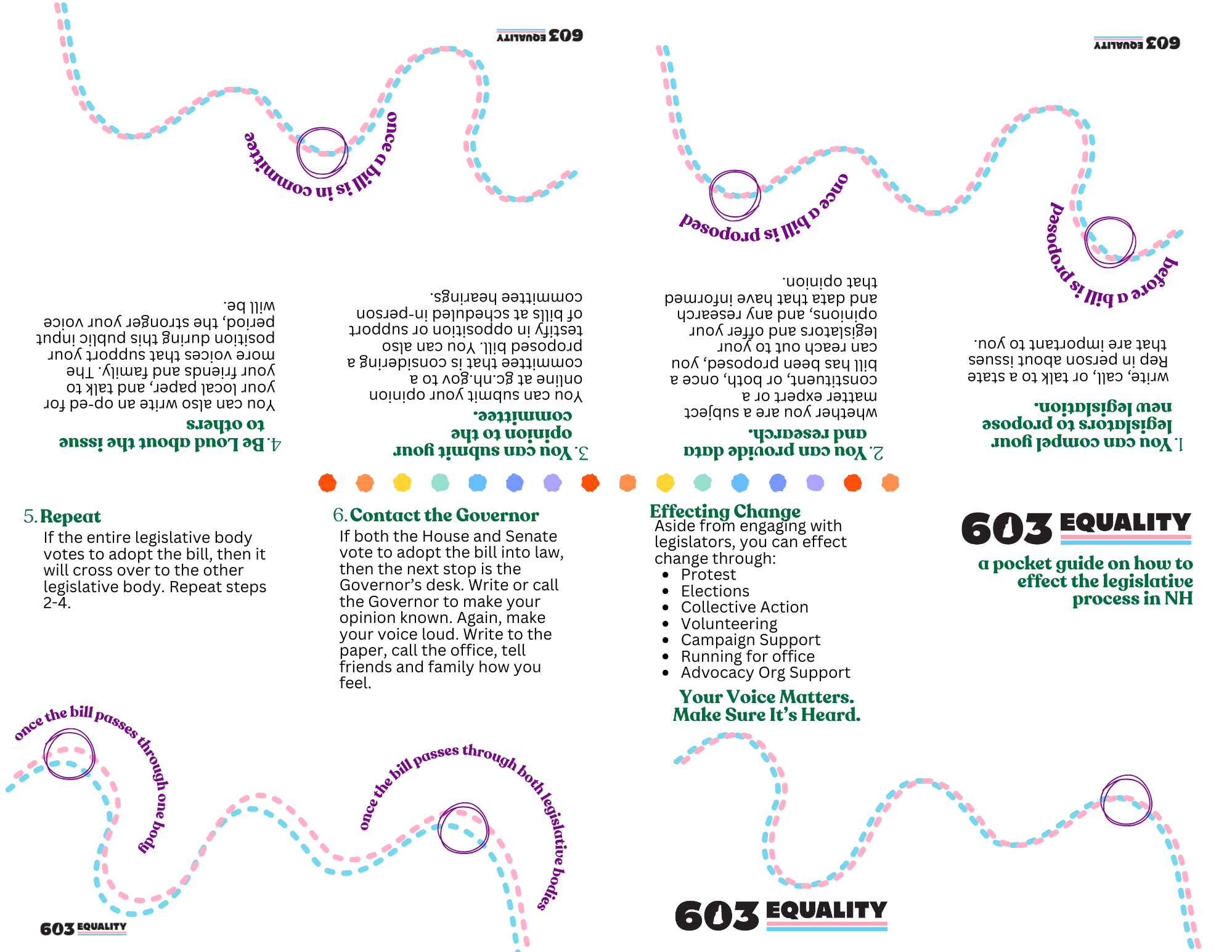
Pocket Guide to Effecting Legislation
This printable pocket guide to legislation fits on an 8.5×11” sheet of paper. You can cut along the rainbow guides in the center of the sheet to fold into a small booklet. It outlines the legislative process for new bills in the state of NH, and the points at which you can engage with that process and how. Click the image to download a printable PDF, or click here.
How to Testify Booklet
This printable booklet prints to sheet of paper. It outlines the process of testifying in the New Hampshire legislature for both the House and the Senate. Click the image to download a printable PDF, or click here.
New Hampshire Legislature Glossary of Terms
-
If a Representative believes that the Speaker of the House is not issuing rulings in good faith, a Representative can challenge the ruling. If the challenge is seconded, a full body vote is taken.
-
A summary report written by a committee clerk to capture public remarks and committee opinions during a public hearing.
-
A New Hampshire Committee of Conference (CoC) is a temporary, bipartisan panel of House Representatives and Senators appointed to reconcile differing versions of legislation passed by both chambers
-
These items will be voted without debate, with a single motion to “approve the consent calendar” because the full legislative body consents to vote on them wholesale and adopt committee recommendations.
-
When a bill is taken off the consent calendar it’s because a legislator wants to include it in floor debate / discussion, and usually go against committee recommendations.
-
Crossover Day is a critical legislative deadline, often occurring around the midpoint of a state legislative session, by which a bill must pass out of its house of origin (House or Senate) to remain viable for the rest of the session. Bills that fail to cross over by this deadline will die for the year, allowing for the legislature to focus on higher priority legislation.
-
As in, “The motions are dilatory.” The Speaker of the House believes the motions are being made as a tactic to waste time, and not being made in good faith.
-
A Full Body Vote that just counts the numbers of how many legislators voted for what. No names are recorded.
-
Enrolling a bill is the final legislative step where a bill, having passed both houses of state legislature in identical form, is printed on paper, certified, and signed by presiding officers. It acts as the official, authenticated version of the legislation, which is then sent to the Governor for signature or veto.
-
Executive Session - AKA “this bill needs further discussion in the executive session” When you hear/see this it means the committee is continuing discussion outside of the hearing.
-
Full Body Vote - AKA “this bill is having the entire legislative body vote on it” When you hear/see this it means that either the entire house, or the entire senate, is voting.
-
When a bill is recommended for interim study, it’s de-prioritized on the legislative calendar, and usually planned for review after at a later date. Bills can and do come out of interim study, but often they do not as other legislative priorities emerge.
-
Inexpedient to Legislate - AKA “this bill is a bad idea.” When you hear/ see this it means that the bill is being recommended to not proceed. If the entire committee recommends ITL, the bill is often killed at that stage. If the committee is split by more than two votes, then there will be a majority report and a minority report.
-
When a committee is split by more than two votes, it cannot make recommendations on consent, and a legislator who agrees with the majority’s recommendation will draft a majority report.
-
When a committee is split by more than two votes, it cannot make recommendations on consent, and a legislator who agrees with the minority’s recommendation will draft a minority report.Item description
-
Ought to Pass - AKA “this bill is a GOOD idea.” When you hear / see this it means that the committee is recommending it to move onto the next stage of the process. If the committee is split by more than two votes, then there will be a majority report and a minority report.
-
Ought to Pass with an amendment - AKA “this bill is a GOOD idea but with this amendment.” If the committee is split by more than two votes, then there will be a majority report and a minority report.
-
A direct question asking for a vote / opinion. This is part of procedure. No debate allowed
-
If the Governor takes no action on an enrolled bill within 5 days while the state legislature has adjourned, the bill dies automatically.
NOTE: If the Governor takes no action within 5 days on an enrolled bill while the legislature is in session, it automatically becomes law.
-
Each legislator’s vote is recorded along with their name in public record to ensure acountability.